| |
Rationale
Knowing the structure of the flow around a body and how fluid velocity
and body geometry change this structure provides useful insight into the
source of lift and drag. In low powered HPVs, both of these quantities are
major factors in determining vehicle performance.
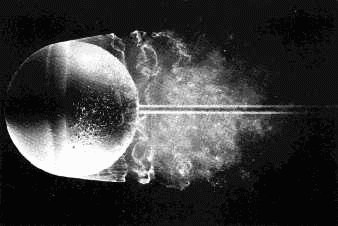
Visualizing a flow
by the introduction of markers permits a rapid evaluation of the interaction
between the body and the fluid. If the flow is laminar the streamlines tend to
follow the surface of the body. When the flow becomes turbulent the streamlines
are less orderly and the boundary layer region, in which the flow goes from
zero velocity at the body wall to the velocity of the free stream, increases
in thickness. Certain body shapes induce the shedding of vortices behind
the body above some fluid velocity and flow recirculation may occur. |
|
|
|
|
|
|
|
|
|
|
|