Table of Contents

Experimental Projects

Menu

Prev

Next

Rationale

Lift and drag result from the pressure and shear stresses acting on a body in relative motion to a fluid in which it is immersed. These quantities are strongly dependent upon the shape of the body and its orientation with respect to motion vector.

In human powered aircraft and hydrofoil boats the challenge is to obtain the required lift from the wing at minimum drag. In addition to the drag associated with the lifting surface, the pilot compartment and other structures such as support wires will contribute to drag. These vehicles will normally not move in a stationary fluid and it is the net motion with respect to the fluid that determines their aerodynamic behavior.

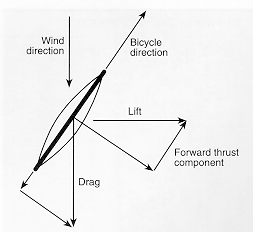
The diagram shows the forces acting on a wheel moving at an
angle to the wind. The drag force is in the direction of the wind and the lift force normal to this. By placing a wheel in a wind tunnel and mounting it on a balance that can measure these forces, the performance of a wheel can be evaluated as a function of the wind velocity and the angle between the plane of the wheel and the wind velocity. Rotating the wheel at different angular velocities can simulate different road speed conditions. Data of this type is of value in selecting wheels to be used under different racing conditions, and gives a measure of the effect of wheel
aerodynamics on the stability of the bicycle.