| |
Rationale
In
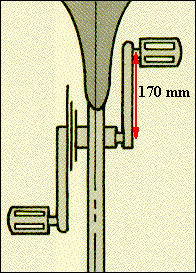
designing components for HPVs such as shafts to carry the pedals
and the chain wheel, the sprocket and hub that is torsionally loaded by the
chain forces required to turn the propellor or rear wheel, and frame components
that will twist due to dynamic loads, it is necessary to consider the elastic
response of these components and its dependence on material choice and component
geometry.
As with tensile and compressive loading, the material
will initially behave in an elastic way and the engineer is normally limited
to this range in designing a component. The geometric form of the material
also determines the magnitude of its response to torsional loading. A slender
rod will twist more than a tube of the same mass made of the same material,
and the longer the rod or tube the greater will be the
twist at the free
end for a given applied torque. These issues are to be explored by studying the
response of rods and tubes of different materials to torsional loads. |
|
|
|
|
|
|
|
|
|