|
Lift
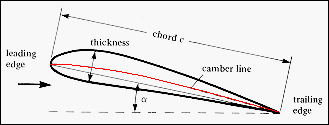
in airplanes is largely provided by the wings. The top diagram shows a
cross-section of a wing and defines some of the parameters required to
understand its properties. The airflow if from the left, and normally the
leading edge of the wing is the first part to interact with the flow. The
chord, c, is the local width of the airfoil section between the leading
and trailing edge, and may be constant over the wing-span, b, or vary with
position along the span. The camber line follows the center of the wing
thickness and its form depends upon the wing design. The line joining the
leading and trailing edges may be parallel to the airflow or inclined at
some angle to the flow. This angle, a,
is known as the angle of attack and may be either positive (leading edge
up) or negative (leading edge down). The ratio of span to chord is the
Aspect
Ratio = (b/c) = (b2/S). S
= wing area = (<c> x
b).
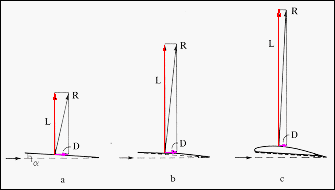
The
lower diagram illustrates how lift and drag depend upon the shape of the
airfoil for a given angle of attack. The flat plate (a) has the lowest
lift, the cambered plate (b) has a higher lift and a lower drag, and the
cambered airfoil section (c) has the highest lift and the lowest drag of
the group. Early planes and HPVs used cambered plate airfoil sections,
later designs have used specifically designed low-speed cambered airfoils. |
|
|
|
|
|
|
|
|
|
|
|
|