| |
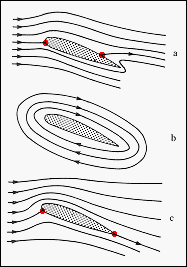
The airflow
around a wing be understood by using a combination of an inviscid (a)
and circulating flow (b) to yield the actual flow pattern (c). From the point
of view of the wing shown in the diagram, the airflow is from the left. The
most obvious "failing" of the inviscid picture is the location of
the rear stagnation point on the upper surface of the wing in front of the trailing
edge, a situation that requires the infinite acceleration of the local
flow to achieve. In addition, the pressure distributions on the top and bottom
surfaces give exactly balanced forces and so there is no lift or drag.
The addition of the circulating flow shown in (b) to that in (a) produces
the physically realistic flow of (c). Here the rear stagnation point is
at the trailing edge of the wing. The flow streamlines join here without unphysical
accelerations being required. The circulation shown in (b) increases
the flow speed over the top of the wing, and reduces the flow speed over the
bottom of the wing. This reduces the pressure as the flow accelerates over
the top of the wing and gives a higher pressure on the lower surface as the
flow expands and decelerates. This pressure distribution generates the desired
lift and creates the associated drag. |
|
|
|
|
|
|
|
|
|
|
|