|
Analysis
The
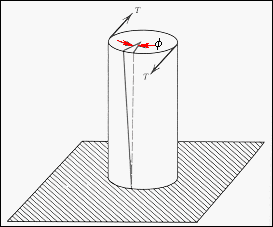
diagram shows the response of a cylindrical sample to a torsional load
at its free end. The loaded end of the rod rotates through an angle
f due to the application
of the torque T. Within the elastic range, the angle
f increases linearly with
distance from the fixed end. The shear strain,
g, produced by the twist
is zero on the long axis of the rod and increases linearly with radial
distance from the axis to a maximum value: gmax
= T r/ J
, where J is the polar moment of inertia of the rod. For a circular cross
section of radius, r: J = pr4/2.
In the elastic range the shear strain, g,
is related to the shear stress, t,
through the shear modulus G : t
= G g
Plot
torque-deflection curves for the different samples. How does the plot depend
on the polar moment of inertia, J, of the sample? For a tube with an outer
radius r1 and
an inner radius r2:
J
= (p/2)(
r14 - r24 ).
How does the plot of torque v. deflection depend on the laser location
for a given sample? |
|
|
|
|
|
|
|
|
|
|