| |
Coulomb
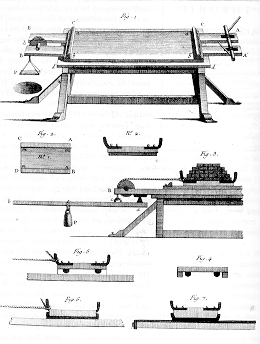
carried out his experiments on friction in 1779 in response to a prize offered
by the Paris Academy of Sciences. The equipment shown was used to study
both static and sliding friction and his results were published in a 1781 paper,
"Theorie des machines simple." The materials tested were of interest
to the French navy and included various woods, iron, and copper. The
surface of the table (fig. 1) was used with the interface between it an the
sled (figs, 2, 3) being dry or lubricated with water, olive oil, tallow, axle
grease, and soot.
These experiments arrived at the same conclusions
as da Vinci and Amontons for static friction. Coulomb found that once the F
= mN threshold was passed and sliding
began the friction force was reduced and essentially independent of the relative
velocity between the contacting surfaces. His observations of metals sliding
on metal without any lubrication indicated a very small difference between
the static and sliding friction.
In explaining the physical mechanism
for friction, Coulomb divided the interaction into a load dependent term
due to the mechanical interaction between surface roughness features and a smaller
term due to the adhesion between the two materials. |
|
|
|
|
|
|
|
|
|
|