 |
|
|
|
|
|
|
|
|
|
|
|
|
|
|
|
|
|
|
|
|
|
|
|
|
|
|
|
|
|
|
|
|
|
|
|
|
|
Failure
Mechanisms |
|
|
|
|
|
|
|
|
|
|
|
|
|
|
|
|
|
|
|
|
|
|
|
|
|
|
|
|
|
|
|
·
In
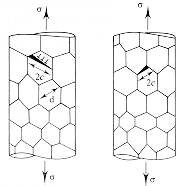
addition to this Mode I brittle fracture, brittle fracture that has some
microscopic plastic deformation as a precursor to crack propagation can
also occur (Mode II). This is illustrated below. |
|
|
|
|
|
|
|
|
|
|
|
|
|
|
|
|
·
Plastic
deformation within a grain leads to crack creation through dislocation
pile-up. These cracks can cleave the grain giving intragranular brittle
fracture.
· Grain
boundary separation during the microscopic plastic deformation process
gives rise to cracks that can propagate in an intergranular brittle fracture
mode.
|
|
|
|
|
|
|
|
|
|
|
|
 |
|
|
|
|
|
|
|
|
|
|
|
|
|
|
|
|
|
|
|
|
|
|
|
|
|
|
|
From:
Courtney, "Mechanical Behavior of Materials," McGraw Hill (1990) |
|
|
|